The simulated world

Two states share one mine. The treaty that splits it runs out on 31 December. We invented all of it, then wrote ten weeks of its news, so the AI tools had a world to work on.

  • 11,094posts, articles and documents
  • 39channels
  • 12news outlets
  • 10weeks, to the morning of 10 Nov
  • 2states in dispute

One copper mine, shared or fought over by two countries

Republic of Ravelia

Ravelia

Its position

The treaty governing the mine must stay unchanged: we split the mine's revenue 50/50.
Capital
Ostrinsk
People
About 9 million
Regime
Parliamentary republic
Mood
Anxious and tired
Leads it
Leonid ZabelinPrime Minister
Coalition
77 of 150 seatsA majority of one; the hardline Krepost holds 29
Republic of Taldara

Taldara

Its position

We've discovered most of the ore is on our side, so the split should be redrawn.
Capital
Tamuneson Lake Tamun
People
About 7 million
Regime
Federal presidential republic
Mood
Proud and tense, more united
Leads it
Ruben KorrandPresident
President's party
78 of 120 seatsThe Lakeland Union

Most of the ore lies on Taldara's side. The processing plant, the cableway that carries the processed ore off the plateau, and the road out are on Ravelia's.

And a neutral diplomat in the middle

The neutral state

Aurelan

Its position

We have no stake in the mine, and we take no side.
Capital
Port Ellaby
People
About 6 million
Regime
Parliamentary republic
Role
Elected member of the Committee on Peace*
Leads it
Doran PikePrime Minister
Foreign minister
Margaret Ashby
The diplomat

Ilse Maren

First Secretary (Political) at the Aurelan embassy in Ostrinsk, Ravelia's capital

Posting
Two years into a three-year posting
Covers
Politics and the conflict
Reports to
The Uplands DeskMinistry of Overseas Relations, Port Ellaby
Ambassador
Tobias Wren

Her tasks this week

  • Report to the capital and advise whether Aurelan should co-sponsor the draft resolution
  • Run the media watch while the press assistant is away
  • The capital decides; the co-sponsor list closes
  • The Committee on Peace votes*
  • Follow the third round of talks
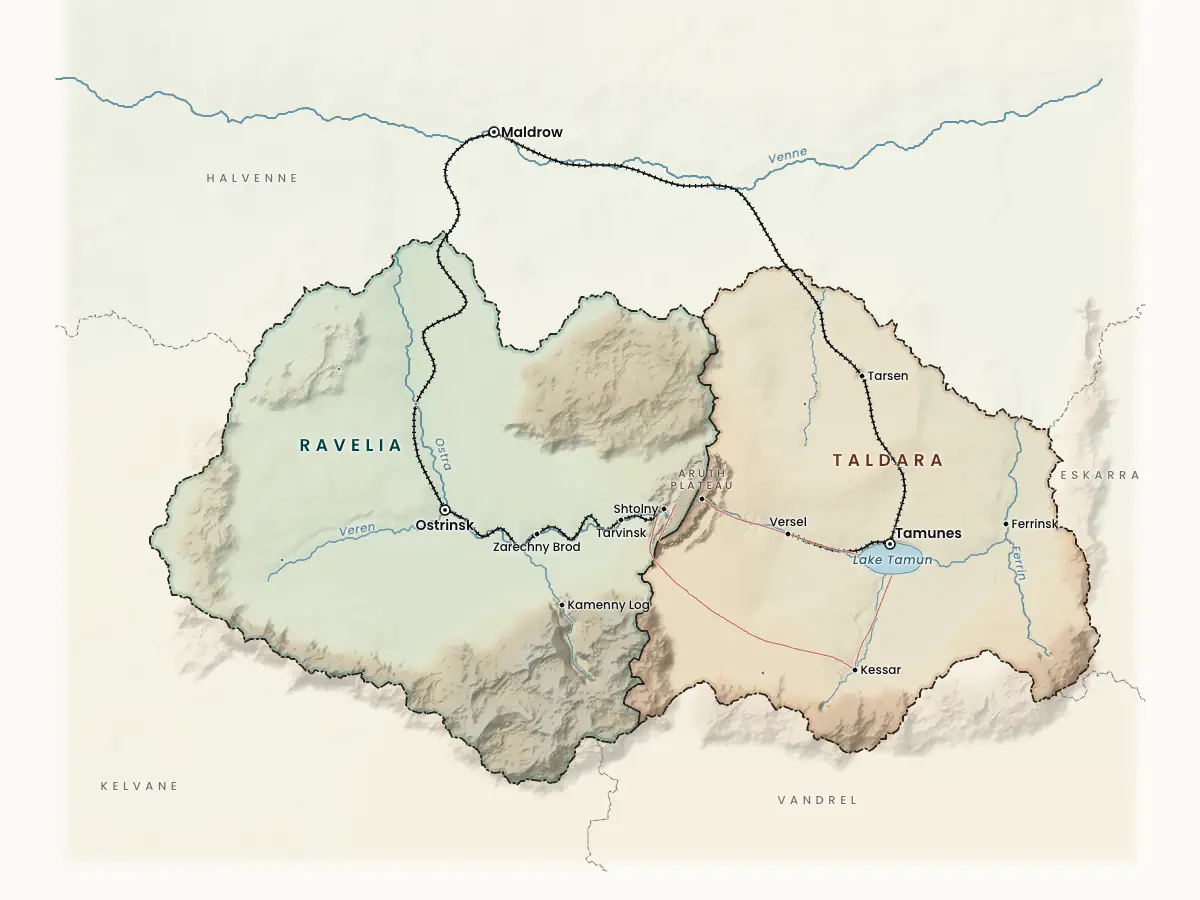
Map of Ravelia, Taldara and the Aruth Plateau between them
  1. A plateau on the border

    The Aruth Plateau rises on Ravelia's eastern border with Taldara. Scroll to cross it.

  2. 1 / 4 · The plateau

    Ravelia and Taldara have mined the Aruth ore field together for forty years under the Plateau Convention. The Convention expires in seven weeks.

  3. 2 / 4 · Dunmar

    Most of the ore lies on Taldara’s side, here at Dunmar. But the cableway and haul road that carry the ore out run through Ravelia.

  4. 3 / 4 · The cableway

    More than nine weeks ago an explosion wrecked the cableway station and killed four workers. Ravelia calls it a drone attack; Taldara calls it an industrial accident. The mine has shipped nothing since.

  5. 4 / 4 · The Orreth saddle

    Fighting followed along the border, including a firefight here nearly four weeks ago. Talks are due to resume on Friday.

The mine

The mine produces copper concentrate. The concentrate also contains gold. One joint authority runs the mine for both states.

  • About 4,800 jobsIn normal times, about 4,800 people from both states work at the mine.
  • Government revenueThe mine provides about 10% of Ravelia's state revenue and about an eighth of Taldara's.
  • Stopped on 4 SeptemberAn explosion destroyed the cableway station. Shipments had already fallen from 40,600 tonnes in June to 28,700 in August; in October they were 0.
  • The cause is disputedFour Ravelian workers died. Ravelia blames a drone attack by Taldara. Taldara denies it and calls it an industrial accident.
  • A 50/50 splitThe treaty splits the mine's revenue equally between the two states.
  • The treaty ends on 31 DecemberBoth states must agree in writing to renew it.

A forty-year-old treaty, up for renewal

The Plateau Convention set up a joint authority to run the mine, and splits the revenue 50/50. It ends on 31 December unless both states renew it.

At the end of each term, either state may ask to change the split, taking account of the original survey and later geological data. That is why a new survey matters.

The original joint survey, 41 years ago

The two states surveyed the deposit together. They found about the same amount of ore on each side. Equal shares followed.

Taldara's new survey, this summer

This summer, Taldara completed its own survey and published a summary. It claims that about 70% of the remaining ore is on Taldara's side. Ravelia rejects it, because Taldara drilled only on its own side and the adjoining ground, and estimated the ore on Ravelia's.

The existing treaty says any change to the split must take account of the original survey and later geological data. Taldara has formally asked to change the split and has proposed arbitration. Arbitration needs the consent of both states, and Ravelia has refused.

Without a treaty, the joint authority would most likely close: wages and revenue would stop, and winter snow would leave the mine idle until spring. After that, Ravelia would have the plant and the road out but would have to rebuild the operation around its own side, while Taldara would have its ore field but no practical way to move ore in volume, so both would earn far less than they do together.

Ten weeks of news and socials before ‘today’

From 1 September to midday on Monday 10 November, the world's channels, news outlets and governments put out more than 11,000 posts, reports and statements. Much of it is about the dispute, but it also carries the everyday posts that fill any real feed, because AI tools must find the signals amid the noise. Each bar is one day.

  1. An explosion wrecks the cableway station at Kanatnaya, killing four workers.

    That day, 35 channels post: grief, anger, calls for revenge, pleas not to trust the first forwards, and Taldara urging everyone to wait for an inquiry.

    188 items · 182 posts and 6 news reports
  2. Halvenne, as chair of the Council, announces a truce from midnight.

    Taldara's loyal channels hail it as their win, Ravelian hardliners sneer at the mediators, and a careful diarist warns that it settles nothing.

    243 items · 230 posts, 11 news reports and 2 official statements
  3. A firefight breaks out in thick fog at the Orreth saddle.

    Ravelia's border service reports an ambush; Taldara's channels say Ravelia fired first. As in real life, posts on everyday matters carry on too, such as a school meeting that has moved.

    236 items · 221 posts, 12 news reports and 3 official statements
  4. Scheduled blasting at the mine and a power cut send people out of their homes.

    A rumour of attack spreads across the channels within minutes, and both governments say the blasting was planned. That afternoon, Taldara calls up its reservists.

    310 items, the busiest day · 296 posts, 11 news reports, 2 videos and 1 presidential decree

Social media communities

OSINT analysts group social media channels into communities: channels that share an outlook, an audience and a way of talking. This world has 39 channels in eight communities. Almost all of them post in Russian.

The eight communities

Scroll sideways through the communities

Ravelian channels carry about three times as many items as Taldaran ones.

Ravelian channelsTaldaran channelsRegional, 194

One channel from each community

A single channel is one voice inside a community. Each card shows one post from the simulated world, translated from Russian.

Scroll sideways through the channels

The other players

Two outside bodies are working on the dispute. One neighbour also has a direct stake in the mine.

HalvenneKingdom · about 21 million

The larger neighbour of both states. It chairs the Council of the Upland States this year and announced the truce of 26 September. Its smelters buy most of the mine's output.

The Councilof the Upland States · 6 members

The regional body that mediates between the two states, based in Maldrow. Its six members include Ravelia and Taldara. Its envoy, Marit Holm, will shuttle between the capitals for the third round of talks on Friday 14 November.

The Committee on Peace11 members, at Halsmere

Part of the General Congress of States, the world body. Eleven elected members, including Aurelan but neither Ravelia nor Taldara. On Wednesday it votes on a draft resolution about the plateau, which needs a two-thirds majority.

How we built this world

We built a simulated world so that we could develop and test a wide range of AI tools for diplomats. The world is far simpler than the real one, but it has some of its complexity: news reports, official statements, social media and an embassy's own files, with true facts mixed in among rumour, spin and misinformation. Every state, person, outlet and post is invented, and we know what really happened, so we can measure how well each tool tells the true from the false. The world is also easy to extend: we can add new weeks, sources or events to develop and test new tools.

1. We designed the world

A leading AI model wrote the world's rulebook: its states, people, news outlets and 39 channels, each with its own outlook and voice. It then wrote briefs for every key item and for each channel's week.

2. AI models wrote it

Smaller AI models wrote the posts, articles and documents to those briefs, covering ten weeks, and scripts added the forwards and reposts: 11,094 items in all.

3. We checked every item

Scripts checked every item for names, dates and real people or places. Checker models also read every key item and one in twenty of the rest against its brief and the rulebook.

All of this leads to her Monday.

Monday 10 November. Ilse Maren has until 14:00 to tell her capital what is going on. Follow her morning, and the AI tools that help her through it.

Follow her Monday